
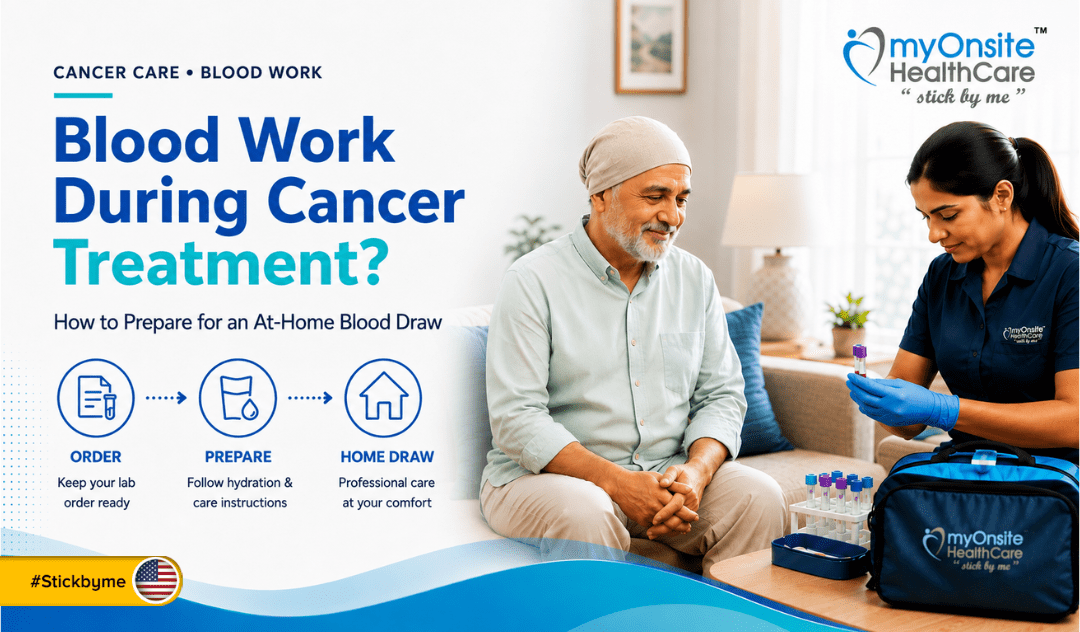
Cancer treatment can turn a simple blood test into another exhausting trip. You may already be dealing with chemotherapy appointments, fatigue, nausea, limited mobility, or days when leaving home just feels like too much. If your care team needs blood work, an at-home blood draw may give you another option.
Instead of traveling to a collection site, a mobile phlebotomist comes to your home, collects the ordered specimens, labels and prepares them, and coordinates them for laboratory testing.
Can cancer patients have blood drawn at home?
Yes, many cancer patients can have blood work collected at home when mobile collection is appropriate for the test and their care plan.
Whether it can be arranged depends on the laboratory order, the tests requested, the receiving laboratory, your location, and any instructions from your oncology team.
myOnsite Healthcare provides at-home blood draw and mobile phlebotomy services in supported areas. Availability is confirmed based on ZIP code and appointment details.
Need blood work at home?
Why blood work matters during cancer treatment
Blood work during cancer treatment isn’t simply another item on the appointment calendar.
Cancer care teams can use blood tests to monitor cancer treatment, including blood cell counts and information about how organs such as the kidneys and liver are functioning. A complete blood count, or CBC, measures red blood cells, white blood cells and platelets and can be used to monitor health during and after treatment.
If you’re wondering what your care team may be looking for, here’s a closer look at what doctors check in blood tests before chemotherapy.
Some cancer treatments can also lower white blood cells, including neutrophils, which can increase the risk of infection. The National Cancer Institute notes that blood tests may be used during chemotherapy to check for neutropenia.
That means the timing of a blood draw can matter.
If your oncologist requested blood work on a particular day or before your next treatment, don’t move the appointment without checking with the care team first.
Before the phlebotomist arrives, check these things
Preparing for a home blood draw during cancer treatment doesn’t need to become another complicated task.
A few basics can make the visit smoother:
- Confirm the date and timing requested by your oncology team.
- Keep your laboratory order or testing information available.
- Follow fasting instructions only if your doctor or laboratory has given them to you.
- Take medications as directed unless your healthcare team specifically tells you otherwise.
- Drink fluids according to the guidance your care team has given you.
- Wear clothing that gives the phlebotomist easy access to your arm.
- Have identification and insurance information available if requested.
- Tell the phlebotomist about difficult veins, previous blood-draw problems, or restrictions involving either arm.
- Keep information for your ordering physician or oncology team nearby.
If you’re wondering about hydration, our guide explains how much water to drink before a blood draw and why normal hydration may sometimes make collection easier.
You don’t need to turn your home into a clinic. A clean, comfortable, well-lit place where you can sit safely is usually what matters.
Should I drink water before an at-home blood draw?
For many blood draws, being normally hydrated can help make the collection process easier.
Cancer treatment can make this advice more individual, though. Some patients have specific fluid instructions because of their treatment, medications, kidney function, heart conditions, or other health concerns.
So don’t suddenly drink a large amount of water just because the phlebotomist is coming.
Follow the hydration instructions your cancer care team has already given you.
And if your test requires fasting and you’re unsure whether water is allowed, check with the ordering provider or laboratory before your appointment.
Tell the phlebotomist about difficult veins
This part matters, especially if you’ve been through repeated blood draws or treatment.
Maybe one arm usually works better than the other. Perhaps technicians often use your hand. You may have swelling, previous lymph-node surgery, a vascular access device, or instructions from your oncology team about which areas should not be used.
Tell your phlebotomist before the collection begins.
If blood draws have been difficult in the past, these tips for an easier blood draw may also help you feel a little more prepared.
Mention it beforehand if you tend to feel faint, bruise easily, take blood-thinning medication, or have had problems during previous collections.
A small bit of information upfront can make the appointment much easier to navigate.
What happens during a home blood draw?
From the patient’s side, a home blood draw is usually pretty straightforward.
The mobile phlebotomist arrives at the scheduled location with the collection supplies. Your identity and order are confirmed, the specimen is collected and labeled, and it is prepared for transport to the appropriate laboratory.
Then comes the part many patients appreciate: you don’t have to make another trip just to have the specimen collected.
No extra drive. No parking. No separate waiting room.
If you’re deciding whether home collection makes sense for you, our comparison of mobile phlebotomy vs. traditional lab visits explains some of the practical differences.
For someone already spending a lot of time navigating cancer care, taking one trip off the schedule can matter.
Need labs before your next treatment?
You may not have to make another trip to a collection center.
What if I’m immunocompromised?
Some cancers and cancer treatments can reduce the body’s ability to fight infection. Chemotherapy, for example, can lower infection-fighting white blood cells.
Infection deserves extra attention during cancer treatment. According to the CDC, about 1 in 5 sepsis hospitalizations are cancer-related. Learn more about infection and sepsis risk for people with cancer.
The National Cancer Institute also notes that infections during cancer treatment can become serious and may require urgent medical attention.
That’s one reason professional infection-control and specimen-handling practices matter when you’re arranging mobile phlebotomy during treatment.
There’s an important distinction here, too:
A scheduled home blood draw is not a substitute for urgent cancer care.
If you develop a fever or another symptom your oncology team has told you requires immediate attention, contact your healthcare team rather than waiting for the phlebotomist.
The NCI identifies a fever of 100.5°F (38°C) or higher among possible signs of infection during cancer treatment, but follows the specific instructions and temperature threshold given by your own oncology team.
What makes at-home blood draws useful during cancer treatment?
Convenience can sound like a small thing until you’re the person trying to fit one more appointment into cancer treatment.
If you’re exhausted after treatment, have difficulty getting around, depend on someone else for transportation, or need blood work regularly, removing an extra trip may make the week a little easier.
We’ve also looked more closely at the benefits of mobile phlebotomy for oncology patients, especially for people managing frequent testing, fatigue or mobility challenges.
Mobile phlebotomy may be useful when blood work needs to fit around:
- Chemotherapy or other treatment appointments
- Telehealth visits
- Repeated laboratory orders
- Chronic-condition monitoring
- Mobility limitations
- Transportation challenges
- Caregiver schedules
The blood test itself isn’t changing. You’re simply changing where the collection happens.
Why patients choose myOnsite Healthcare for home blood draws
When you’re already dealing with cancer treatment, you probably don’t want more uncertainty around something as basic as getting blood drawn.
myOnsite Healthcare provides professional home blood draw and mobile phlebotomy services. According to its current home blood draw information, myOnsite’s phlebotomists are employees who are trained, background checked, licensed and insured. The company also reports 16+ years of mobile phlebotomy experience and a 99% customer satisfaction rating.
Home collection can be particularly helpful for patients dealing with chronic illness, mobility limitations, frequent laboratory testing, or demanding treatment schedules.
Service availability does vary by location. myOnsite currently confirms requests based on ZIP code and appointment availability, so checking your area is the easiest place to start.
How do I schedule a home blood draw during cancer treatment?
If your oncology team has ordered blood work, start by having the order details available.
It also helps to have your:
- ZIP code
- Contact information
- Ordering provider information
- Laboratory information, if provided
- Requested collection date or treatment date
- Any special collection instructions
Then contact myOnsite Healthcare with the details of your request.
The current service process is simple: submit an inquiry or call the team, myOnsite reviews the request and confirms availability by ZIP code, and then the team helps with scheduling and next steps.
Ready to see if a phlebotomist can come to you?
Prefer to speak with someone? Call myOnsite Healthcare at (941) 271-0701.
Sometimes the helpful part isn’t another medical innovation. It’s simply being able to take one more trip off your schedule when you’re already going through enough.
Frequently Asked Questions
Can someone come to my house to draw blood before chemotherapy?
Often, yes. If your oncology provider has ordered laboratory testing and mobile collection is appropriate for those tests, a phlebotomist may be able to collect the specimens at home. Availability depends on your location, laboratory requirements, order and treatment team’s instructions.
Do I need a doctor’s order for an at-home blood draw?
Many laboratory tests require an order from a healthcare provider. If your blood work is part of cancer treatment, keep your oncology team’s laboratory order or testing information available when arranging the appointment.
Can a CBC be drawn at home?
In many situations, the blood specimen needed for a CBC can be collected outside a traditional laboratory. A CBC measures components including red blood cells, white blood cells and platelets. Whether your particular test can be collected at home depends on your order, receiving laboratory and handling requirements.
Can I get blood drawn at home before my oncology appointment?
Potentially, yes. The important part is making sure the collection happens within the timeframe requested by your oncology team and meets the receiving laboratory’s requirements.
Can a mobile phlebotomist draw blood from my chemotherapy port?
Don’t assume port access is included with a standard home blood draw. Accessing an implanted port requires the appropriate clinical order, supplies, training and protocols. Ask your oncology team and the mobile collection provider before scheduling.
What if I have difficult veins because of cancer treatment?
Tell the phlebotomist what has worked during previous collections and mention any instructions your oncology team has given you about which arm or collection sites should or shouldn’t be used.
Is a home blood draw an option if my immune system is weak?
It may be, depending on your circumstances and your care team’s instructions. Because some cancer treatments can increase infection risk, follow your oncology team’s precautions and contact them promptly if you develop signs of infection rather than waiting for a scheduled blood draw.
Will my oncologist receive my laboratory results?
That depends on how the laboratory order and reporting process are set up. Confirm the ordering provider and receiving laboratory when arranging your collection so you understand how the results will be delivered.
Does insurance cover mobile phlebotomy?
Coverage can vary by plan, service and medical circumstances. myOnsite states that it accommodates HMO, PPO and Medicare patients and that fees may be covered by insurance or may require a copay, so confirm the details for your specific request before assuming coverage.
How do I know whether myOnsite serves my area?
myOnsite currently provides mobile phlebotomy in supported U.S. locations and confirms availability based on ZIP code and appointment details. If your location isn’t listed, the company recommends contacting the team because coverage may still be available in your ZIP code. Check Home Blood Draw Availability →
Medical Disclaimer
This article is for educational purposes and does not replace medical advice or instructions from your oncology team. Cancer treatment, laboratory requirements, fasting instructions, hydration needs and urgent-care recommendations vary from patient to patient. Follow the guidance provided by your treating healthcare professionals.