
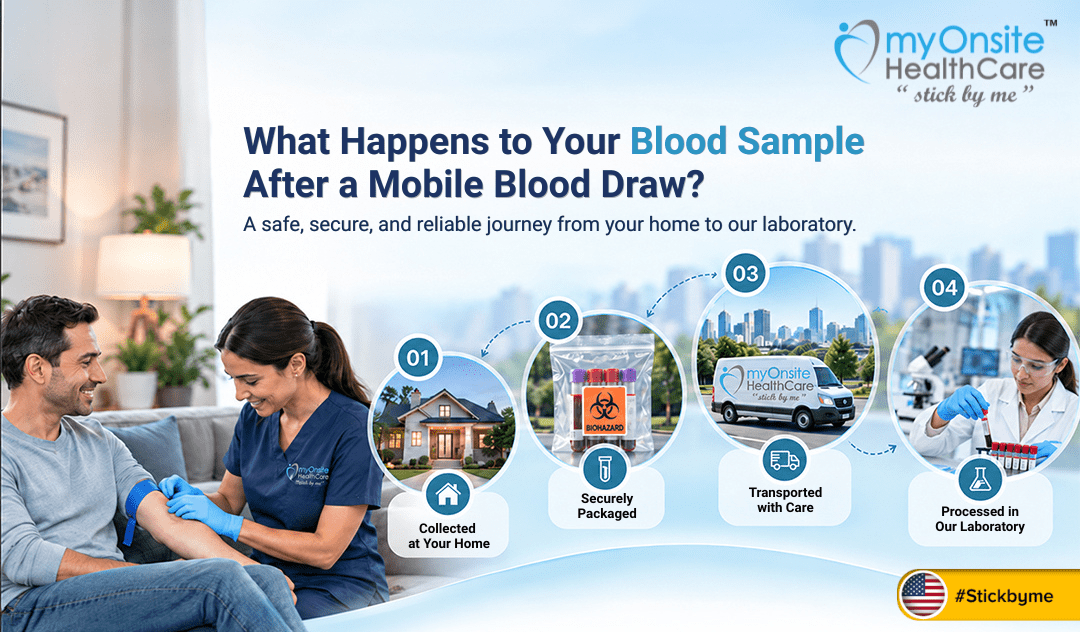
The phlebotomist has finished your blood draw, labeled the tubes, packed everything up, and walked out the door.
Your appointment is over.
Your blood sample, though? Its journey has really just started.
If you’ve ever wondered, Where does my blood actually go after an at-home blood draw? or What happens before the results show up in my portal? – you’re asking a good question. Quite a bit happens after the bandage goes on.
The quick answer
After a mobile blood draw, your sample is typically:
Collected → labeled → handled according to the test requirements → prepared for transport → delivered or routed to the appropriate laboratory → checked and processed → tested → reviewed → reported to your healthcare provider.
The exact process varies depending on the test, laboratory, provider order, and specimen requirements.
That last part matters.
A routine blood count may not need the same handling as a specialized test with tighter temperature or timing requirements. So professional blood collection isn’t simply about getting blood into a tube.
It’s about getting a usable specimen through the entire process that comes next.
First, your blood sample has to stay connected to you
One of the most important steps happens almost immediately after collection: identification.
The blood tubes need to be properly labeled and associated with the correct patient and laboratory order.
It sounds simple, but consider how many hands and systems may be involved before your results come back.
Your sample can move from collection to transportation, laboratory receiving, processing, testing, review, and reporting. Throughout that journey, it needs to remain connected to the right person and the right tests.
This is why patient identification and specimen labeling aren’t small administrative details. They’re part of protecting the integrity of the testing process.
Why did the phlebotomist collect several tubes?
This is something patients ask all the time.
Your healthcare provider orders “blood work,” and suddenly there are three or four tubes sitting beside the phlebotomist.
That doesn’t usually mean something is wrong.
Different laboratory tests can require different collection tubes, additives, or specimen types. Depending on what’s ordered, the laboratory may need:
- Whole blood
- Serum
- Plasma
- A tube containing a particular additive
- A specimen requiring specific handling or processing
Those different colored tube tops aren’t just for organization. They can indicate different additives and uses. If you’re curious about that part, our guide to which color blood tube is used for which test breaks it down in plain language.
So several tubes don’t necessarily mean an unusually large amount of testing.
Often, they simply reflect what the laboratory needs to perform the requested tests correctly.
Then comes the part most patients never see: specimen handling
Once blood leaves your body, the specimen doesn’t just sit around waiting for someone to test it.
Different samples have different handling requirements.
Depending on the test, factors may include:
- Temperature
- Timing
- Light exposure
- Tube type
- Packaging
- Positioning
- Processing
- Transportation conditions
Some specimens can remain at room temperature. Others may require controlled conditions. Certain samples need timely processing.
The WHO Guidelines on Drawing Blood, hosted by the National Library of Medicine, specifically identify factors such as recommended collection tubes, patient-sample matching, staff knowledge, and transportation conditions as things that can influence laboratory results.
That’s an important point for patients.
The quality of laboratory testing doesn’t begin when a machine analyzes your blood.
It begins with the collection and continues all the way to the laboratory.
Have a lab order but don’t want another trip to a draw center?
Mobile collection may be an option depending on your location and the tests ordered.
Check Mobile Phlebotomy Services →
Availability depends on location, appointment availability, laboratory requirements, and the collection requested.
How is blood transported after a mobile blood draw?
This is where mobile blood collection has an extra logistical step.
At a traditional collection center, your blood may already be inside or close to the laboratory system that will process it.
With a home blood draw, collection happens somewhere else. The sample still needs to get to the appropriate laboratory.
That means the specimen needs to be packaged and transported according to the requirements for the tests being performed.
It isn’t simply a case of placing a few tubes in a car and driving away.
Different specimens may have different time and temperature requirements. Packaging also helps protect the specimen and the people handling it.
If you’d like a closer look at this specific part of the process, we explain how mobile phlebotomists transport blood samples safely to the lab in a separate guide.
From the patient’s side, though, this stage is mostly invisible.
The collection bag closes. The phlebotomist leaves. You go back to your day. Your sample keeps moving.
Does the mobile phlebotomist personally take my sample to the lab?
Sometimes the phlebotomist may be directly involved in moving specimens to their next destination. In other situations, an established transportation, courier, or laboratory-routing process may be involved.
It depends on the provider and laboratory arrangement.
The more useful question is:
Does the specimen reach the correct laboratory under the conditions required for that particular test?
That’s what ultimately matters.
A successful mobile blood draw isn’t simply, “We collected the blood.”
It’s, “We collected the appropriate specimen and helped move it through the process needed for laboratory testing.”
That difference happens mostly behind the scenes, but it’s an important one.
What happens when your blood reaches the laboratory?
Arrival at the laboratory isn’t necessarily the moment testing starts.
First, the specimen has to be received and connected with the appropriate order.
Depending on the laboratory and test, that can involve checking things such as:
- Patient identification
- Labeling
- Collection tube
- Specimen quantity
- Condition of the sample
- Suitability for the ordered test
If the sample meets the laboratory’s requirements, it moves forward. If something needs attention, laboratory staff may need to review it.
And occasionally, a specimen can’t be tested.
Nobody wants to hear that another blood draw may be necessary, which is one reason everything that happens before the sample reaches the testing stage matters.
What happens to the blood before testing?
Here’s another part patients don’t normally get to see. A tube doesn’t always go straight from the transport container into an analyzer.
Some specimens need preparation first.
Blood itself contains several components, including red blood cells, white blood cells, platelets, and plasma. Different tests look at different parts of the specimen.
Depending on the test, laboratory staff may separate blood components using centrifugation or perform other preparation before analysis. Other tests use whole blood.
That’s another reason several tubes may be collected during a single appointment.
They may look fairly similar when they’re sitting on the table beside you, but what happens to each one afterward can be quite different.
Then the actual laboratory testing begins
Now your sample reaches the stage most people picture when they hear “blood work.”
Depending on what your healthcare provider ordered, laboratory tests can measure or evaluate things such as:
- Blood cell counts
- Glucose
- Cholesterol and other lipids
- Electrolytes
- Kidney-related markers
- Liver-related markers
- Thyroid or other hormone levels
- Medication levels
- Proteins
- Other biomarkers
Not every test takes the same amount of time.
That’s why you might open your patient portal and find three results available while two others are still pending. That doesn’t automatically mean anything has gone wrong.
Some tests simply take longer to process. Specialized testing may also need different equipment, additional preparation, or routing to another laboratory.
What can make a blood sample unusable?
Occasionally, a specimen doesn’t meet the requirements needed for a particular test.
Possible reasons include:
- Not enough specimen
- Clotting when the specimen should not have clotted
- Hemolysis
- An unsuitable specimen type
- Labeling problems
- Test-specific handling requirements not being met
One term patients sometimes hear is hemolysis.
Hemolysis occurs when red blood cells break down and release their contents into the surrounding specimen. The CDC notes that hemolysis can affect laboratory test results, although whether it affects testing depends on the particular test and degree of hemolysis.
Sample rejection isn’t just a theoretical issue, either.
A large College of American Pathologists study published in the medical literature reviewed 10,709,701 chemistry specimens from 453 laboratories. About 0.35% were rejected before testing, and hemolysis was the most frequently reported reason for rejection. You can review the specimen acceptability study on PubMed.
That percentage may sound small. When you’re the patient who needs another needle stick, it doesn’t feel small at all.
This is why good phlebotomy involves more than making the collection comfortable.
A comfortable draw matters. A usable specimen matters too.
Mobile blood draws depend on the logistics you don’t see
On the surface, mobile phlebotomy sounds wonderfully simple:
Someone comes to you and draws your blood. For the patient, ideally, it should feel simple.
Behind the appointment, however, several moving pieces can be involved: patient identification, laboratory orders, scheduling, specimen requirements, collection, labeling, transport, tracking, laboratory routing, and results.
At myOnsite Healthcare, technology is part of that process.
The myOnsite platform provides functionality to track the status of blood draws and laboratory orders, along with specimen location and temperature within supported workflows. Patients and clients can learn more about myOnsite’s online access and laboratory tracking.
myOnsite also currently reports a 99% customer satisfaction rating for its mobile phlebotomy services.
Those numbers matter, but there’s something more practical behind them. A mobile blood draw only feels convenient when the parts you don’t see are working too.
Already have an order for blood work?
If you’d rather not arrange transportation, drive to a collection center, and wait for your turn, check whether home collection can work for your order.
Have your ZIP code and laboratory-order information available when possible.
When will you receive your blood test results?
There isn’t one turnaround time that applies to every blood test.
It depends on factors such as:
- The test ordered
- The receiving laboratory
- Specimen preparation requirements
- Whether specialized testing is involved
- The laboratory’s turnaround time
Some routine results may become available relatively quickly.
Other tests take longer.
Once testing and any required review are complete, the results are typically released to the healthcare provider who ordered them.
Depending on the laboratory and healthcare system, you may also be able to see them through a patient portal.
One thing worth remembering: a result marked high or low doesn’t automatically tell you what it means for your health.
Your healthcare provider may consider your symptoms, medications, medical history, previous results, other laboratory findings, and the reason the test was ordered.
If a result worries you, talk with the healthcare professional who ordered the testing rather than trying to diagnose yourself from a number on a screen.
Is blood collected at home tested differently from blood drawn at a lab?
Usually, the biggest difference is where the collection happens.
At a traditional draw site, you go to the phlebotomist.
With mobile phlebotomy, the phlebotomist comes to you.
The laboratory still needs the appropriate specimen for the tests being performed.
So identification, collection, labeling, handling, transportation, processing, and testing still matter.
What changes for the patient is the trip.
And that can make a meaningful difference for someone who is:
- Older and no longer comfortable driving
- Recovering from surgery
- Managing mobility limitations
- Going through cancer treatment
- Living with a chronic condition that requires regular blood work
- Trying to fit laboratory testing into an already crowded schedule
The blood sample still needs to reach the laboratory.
The patient doesn’t always need to make the trip with it.
Before booking a mobile blood draw, ask more than “Do you come to my house?”
Convenience matters.
It just shouldn’t be your only consideration.
It’s reasonable to ask:
- Who will perform the blood draw?
- How are samples identified?
- How does transportation work?
- Which laboratory will receive the specimen?
- Can the status of the order be tracked?
- How will results be delivered?
- Who should I contact if something changes?
- What happens if the laboratory needs another specimen?
A good mobile blood collection experience should account for what happens after the needle comes out, not only what happens during the appointment.
The draw takes minutes. The process goes much further.
From your side, a mobile blood draw can feel almost uneventful.
- The phlebotomist arrives.
- You roll up your sleeve.
- A few tubes are collected.
- You get a bandage.
- Then you get back to breakfast, work, family, or whatever else you had planned.
That’s part of the appeal.
But those little tubes still have a lot ahead of them.
- Identification.
- Handling.
- Transportation.
- Laboratory receiving.
- Preparation.
- Testing.
- Review.
- Results.
So the next time a phlebotomist walks out your door carrying carefully packed blood samples, you won’t have to wonder quite as much about what happens next.
Your appointment may be finished.
Your sample’s journey has just begun.
Need blood work without another trip to the lab?
If you already have a laboratory order and getting to a collection location is inconvenient, physically difficult, or simply one more trip you’d rather avoid, myOnsite Healthcare may be able to bring the collection to you.
Learn more about myOnsite’s home blood draw services and check whether mobile collection is available for your needs.
Need blood work without another trip to the lab?
Check Home Blood Draw Availability →
Prefer to speak with someone? Call myOnsite Healthcare at (941) 271-0701.
Frequently Asked Questions
Where does my blood go after a mobile blood draw?
After collection, the specimen is prepared for transportation and routed to the appropriate laboratory for the tests your healthcare provider ordered. The exact destination depends on the order, laboratory arrangements, and testing requirements.
How long can a blood sample stay outside the laboratory?
There’s no single time limit for every blood specimen. Stability varies depending on the test, collection tube, temperature, processing requirements, and other conditions.
Does blood collected at home need to be refrigerated?
Not necessarily. Some specimens require temperature-controlled handling while others do not. Patients generally shouldn’t refrigerate or otherwise handle collected specimens themselves unless specifically instructed to do so.
Can blood samples be safely transported by car?
Yes. Laboratory specimens are routinely transported. Proper packaging, handling, timing, and temperature controls when required help maintain specimen integrity during transportation.
Why did the phlebotomist collect several tubes?
Different tests can require different tube types, additives, or blood components. Several tubes may therefore be necessary even though they’re all collected during the same appointment.
What is hemolysis?
Hemolysis is the breakdown of red blood cells within a blood specimen. It can interfere with certain laboratory measurements, depending on the test and the degree of hemolysis.
Why did some of my blood test results appear before others?
Different tests have different processing and turnaround times. Routine tests may be completed sooner, while specialized testing may require additional preparation or processing.
Can I track my blood sample after a mobile blood draw?
It depends on the provider and laboratory workflow. myOnsite’s platform includes functionality for tracking blood draw and laboratory-order status, as well as specimen location and temperature within supported workflows.
Is blood collected at home suitable for laboratory testing?
The collection location is only one part of laboratory testing. What’s important is obtaining the appropriate specimen and meeting the identification, collection, handling, transportation, and processing requirements for the tests ordered.
How do I know whether my lab order can be completed through a home blood draw?
Contact the mobile collection provider with your ZIP code and laboratory-order information. Availability can depend on your location, appointment availability, receiving laboratory, and the particular tests ordered.