
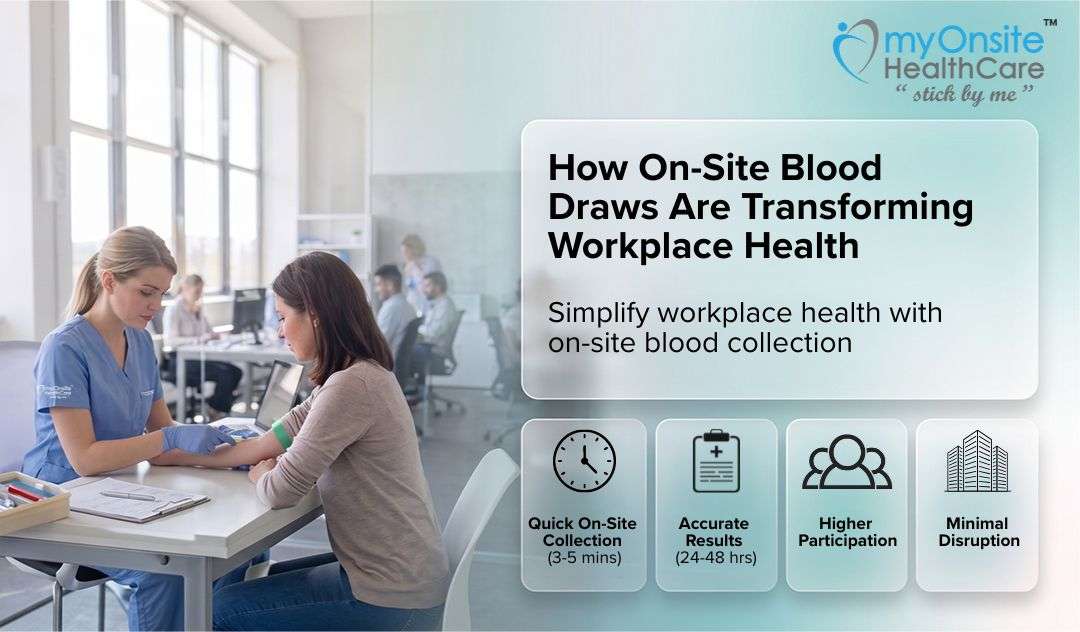
Coordinating lab work for a large group sounds simple at first. Then reality sets in — schedules don’t line up, employees miss appointments, and suddenly your team is chasing updates across emails, calendars, and multiple locations.
That’s usually when organizations start asking a better question: is there a simpler way to handle all of this?
On-site blood collection brings licensed phlebotomists directly to your workplace — eliminating travel, reducing missed appointments, and making the entire process dramatically easier to manage.
What Is On-Site Blood Collection (Mobile Phlebotomy)?
On-site blood collection, also called mobile phlebotomy services, is a healthcare service where a trained professional travels to a workplace, event, or home to perform blood draws and specimen collection.
These services are performed by licensed phlebotomists who follow strict clinical protocols for collection, handling, and transport.
It’s commonly used for:
- Corporate wellness programs
- Employee health screenings
- Clinical trials
- Occupational health testing
- Remote workforce lab support
In simple terms, it removes the need for employees to travel to a lab.
It Saves More Time Than Most Teams Expect
When employees leave work for lab testing, you’re not just losing the 10-minute blood draw — you’re losing:
- Travel time (often 20–40 minutes round trip)
- Waiting room time
- Time getting back into work mode
Multiply that across a large organization, and it adds up quickly.
Research from the CDC’s workplace health programs shows that reducing barriers to healthcare access directly improves participation and outcomes.
With on-site collection, employees step away briefly and return to work quickly, with minimal disruption.
Participation Rates Often Improve
Convenience has a direct impact on follow-through.
When testing becomes easier, more people actually complete it. That matters whether you’re running:
- Employee wellness programs
- Annual health screenings
- Clinical trials
- Occupational health checks
According to research on mobile healthcare delivery models, reducing travel and accessibility barriers significantly improves participation rates in healthcare programs.
From what we’ve seen at myOnsite Healthcare, once organizations switch to on-site collections, participation tends to increase without constant reminders.
It’s More Comfortable for Employees
Not everyone feels comfortable visiting a lab.
Some employees deal with:
- Anxiety around clinical settings
- Mobility limitations
- Tight schedules
On-site blood collection creates a more familiar, low-pressure experience. That makes repeat testing easier, which is critical for long-term health programs.
Logistics Become Much Easier to Manage
Coordinating lab work across a large organization can feel like a full-time job.
You’re managing:
- Appointment scheduling
- Lab coordination
- Status tracking
- Result follow-ups
On-site services simplify this process by centralizing collection and reducing coordination effort. Instead of chasing updates, teams get a more streamlined and manageable system.
Traditional Lab Visits vs On-Site Blood Collection
| Traditional Lab Visits | On-Site Blood Collection |
|---|---|
| Employees travel to a lab | Phlebotomist comes to you |
| Lost work hours | Minimal disruption |
| Lower participation | Higher completion rates |
| Scheduling challenges | Streamlined coordination |
| Clinical setting anxiety | Familiar, low-pressure environment |
How On-Site Blood Collection Works (Step by Step)
Understanding the process helps organizations plan effectively:
- Consultation — Discuss team size, tests, and logistics.
- Scheduling — Set time slots or walk-in windows.
- Setup — Phlebotomist prepares a compliant collection station.
- Collection — Blood draws typically take 3–5 minutes per person.
- Transport — Samples are sent to certified labs under proper protocols.
- Results — Delivered digitally within 24–48 hours.
It Works Especially Well for Distributed Teams
Today’s workforce includes:
- Hybrid employees
- Remote teams
- Field staff
This is where mobile phlebotomy services become especially valuable.
Organizations can arrange collections at offices, events, or offer home blood draw services for remote employees.
If you’re comparing options, this is similar to mobile phlebotomy vs lab visits — it’s about making healthcare accessible wherever people are.
How Reliable Is On-Site Blood Collection?
Organizations often ask:
- Will the samples be handled correctly?
- Will the team be consistent?
Established providers follow strict clinical protocols aligned with industry standards to ensure sample integrity and safety.
At myOnsite Healthcare, the team maintains a 0% sample rejection rate and a 99% patient satisfaction score — reliability that matters at scale.
Many organizations also rely on workplace health screening services to simplify testing programs and improve participation.
So, What’s the Bottom Line?
If your organization is managing employee health programs — or planning to improve them — on-site blood collection is one of the simplest ways to reduce friction and increase efficiency.
It saves time, improves participation, and makes healthcare logistics far easier to manage.