
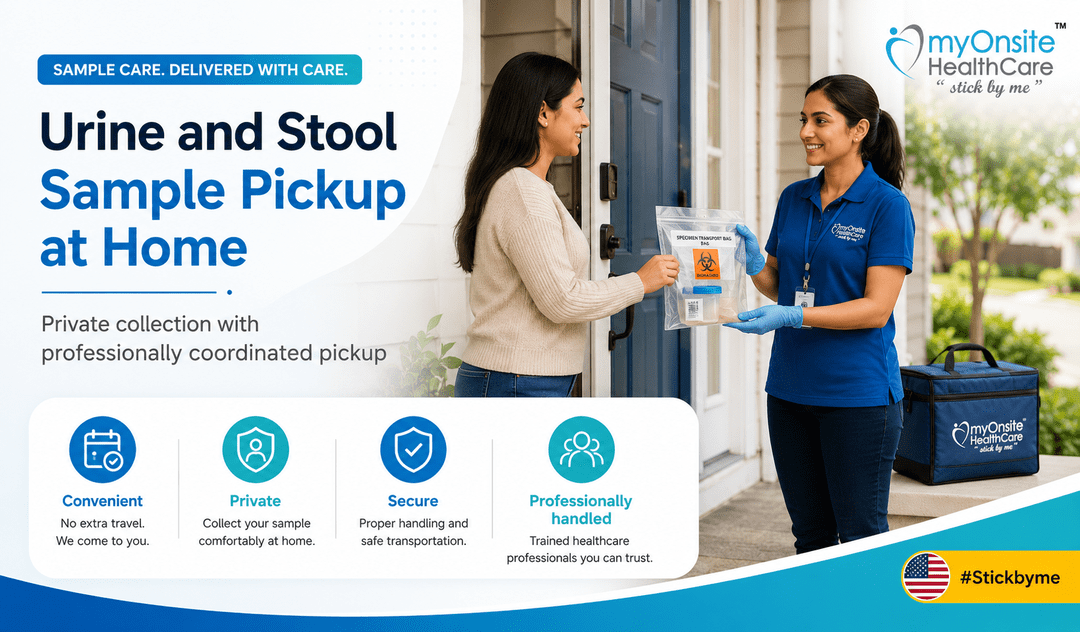
Collecting a urine or stool sample at home may sound simple, but patients often have many questions.
Which container should you use? Should the sample go in the refrigerator? How long can it stay at home? And how will it reach the laboratory safely?
These small details matter because every test has its own collection and storage instructions. A sample collected the wrong way may not be accepted by the laboratory.
At-home sample pickup can make the process easier. You collect the sample privately at home, prepare it according to the instructions, and hand it over to an authorized healthcare professional or pickup team for delivery to the designated laboratory.
Here is what you can usually expect.
Ready to Check Pickup Availability?
Already have your provider order or collection kit? Contact myOnsite Healthcare to find out whether urine or stool sample pickup is available for your test and location.
Please have the following information ready:
- ZIP code
- Type of specimen
- Provider order
- Collection kit details
- Receiving laboratory
- Preferred pickup date
Ready to schedule a sample pickup?
Service availability and collection requirements vary by test, laboratory, and location.
What Samples Can Be Collected at Home?
Many urine and stool tests can be completed using a sample collected at home. However, the process depends on the test ordered by your healthcare provider and the requirements of the receiving laboratory.
Urine testing may include:
- Routine urinalysis
- Urine culture
- Kidney-related testing
- Protein testing
- Hormone testing
- Medication monitoring
- First-morning urine testing
- Timed or 24-hour urine collection
Stool testing may be used to check for:
- Hidden blood
- Bacteria or parasites
- Digestive inflammation
- Certain infections
- Conditions related to colorectal cancer screening
Not every test uses the same type of container.
Some stool kits include a small tube or sampling stick. Others may come with a scoop, collection paper, or a container with a preservative inside it.
The same applies to urine tests. A routine urine sample is very different from a 24-hour urine collection.
Always follow the instructions included with your kit. Those instructions are more important than general advice found online.
How Does At-Home Sample Pickup Work?
The exact process can vary, but most appointments follow a few basic steps.
1. The Test Details Are Confirmed
Before the pickup is scheduled, the team may ask for information about your test.
They may need to know:
- What type of test was ordered
- Whether you already have the collection kit
- Which laboratory should receive the sample
- When the sample needs to be collected
- Whether it must be refrigerated
- Whether there are any special timing requirements
- Whether you have a provider’s order
This step helps prevent mistakes.
Two collection containers may look similar, but they may have completely different handling instructions.
2. You Receive the Correct Collection Kit
Your collection kit may come from your doctor, laboratory, clinical trial team, or specimen collection provider.
The kit may contain:
- A sterile container
- A collection tool
- Patient labels
- Gloves
- A transport bag
- Absorbent material
- Written instructions
- Preservative, when needed
Do not use a household jar, food container, or another container from home.
A household container may not be sterile, leak-resistant, or suitable for the ordered test. Use only the container provided or approved by your healthcare provider or laboratory.
When scheduling the pickup, confirm who is responsible for supplying the kit.
3. You Collect the Sample at Home
Most urine and stool samples are collected privately by the patient or caregiver.
Collecting a Urine Sample
For some urine tests, you may be asked to provide a clean-catch sample. This usually means cleaning the area first and collecting urine after the flow has started.
Other urine tests may require:
- The first urine of the morning
- Collection at a specific time
- Collection before or after taking medication
- Every urination during a 24-hour period
Read the instructions before beginning. Do not assume that your current test is collected the same way as a previous one.
Collecting a Stool Sample
A stool sample usually needs to be collected before it touches toilet water.
Your kit may include a collection hat, paper, scoop, brush, stick, or small tube.
Try to keep urine, toilet water, tissue, soap, and cleaning products away from the sample. These may affect certain tests.
Always follow your kit’s stool sample collection instructions, since the container, collection method, and required amount may vary by test.
You usually only need a small amount, but the exact amount depends on the kit.
Children, older adults, and people with limited mobility may need help from a caregiver. Any need for assistance should be discussed before the appointment.
Already Have Your Order and Collection Kit?
If your provider has already ordered the test and you have the correct collection supplies, contact myOnsite Healthcare to check whether pickup is available in your area.
Have your collection kit? Check if pickup is available.
Helpful information to provide:
- Type of urine or stool test
- Collection date or required timing
- Receiving laboratory
- ZIP code
- Whether the sample requires refrigeration
- Whether the kit is already available
What Should You Do After Collecting the Sample?
Once the sample has been collected, close the lid firmly.
Then label the container exactly as instructed.
The label may need to include:
- Your full name
- Date of birth
- Collection date
- Collection time
- Type of sample
Make sure the information matches the provider order or laboratory paperwork.
Place the closed container inside the transport bag supplied with the kit.
Should the Sample Be Refrigerated?
Do not automatically place the sample in the refrigerator.
Some samples need to stay cold. Others should remain at room temperature. Some containers already have a preservative inside them.
The storage method depends on the test.
When you are unsure, contact the healthcare provider, laboratory, or collection team before collecting the sample. Guessing may lead to the laboratory rejecting it.
What Happens When the Pickup Team Arrives?
At the scheduled time, an authorized team member may arrive at your home to collect the packaged sample.
Depending on the service, they may:
- Confirm your name and date of birth
- Check the specimen label
- Confirm the collection time
- Make sure the container is closed
- Place it inside suitable transport packaging
- Record that the sample was received
The container will normally remain closed.
The person collecting it usually does not need to open or closely inspect the sample at your door. The process is generally quick, private, and professional.
How Does the Sample Reach the Laboratory?
Professional collection teams follow test-specific transport requirements. The CDC specimen packing and shipping guidance also illustrates the importance of layered packaging, documentation, and temperature-appropriate handling.
After pickup, the sample is transported according to the laboratory’s requirements. You can also learn more about how mobile healthcare professionals transport samples safely to the laboratory.
Some samples need:
- Temperature-controlled transportation
- Leak-resistant packaging
- Protective secondary packaging
- Delivery within a certain number of hours
- Transfer to an approved courier or laboratory
Proper packaging helps prevent leaks, damage, contamination, or the sample becoming separated from its paperwork.
When the sample reaches the laboratory, staff check it before testing.
They may review:
- Patient information
- Test order
- Type of sample
- Container
- Label
- Collection time
- Condition of the specimen
If something is missing or incorrect, the laboratory may not be able to perform the test.
Why Might a Sample Be Rejected?
Having to collect another sample can be frustrating. Fortunately, many common problems can be avoided.
A laboratory may reject a sample when:
- The container has no label
- The patient information is incorrect
- The wrong container was used
- The lid is loose
- The container is leaking
- There is not enough sample
- The specimen is contaminated
- The collection time is missing
- It was stored at the wrong temperature
- It arrived too late
- The test order is missing
The best way to avoid these problems is to read the full instructions before starting.
Do not wait until after collecting the sample to check the directions.
Who Can Benefit From Home Sample Pickup?
At-home pickup may be helpful for patients who have difficulty traveling, prefer more privacy, or want to avoid an additional trip to the laboratory.
It can be especially helpful for:
- Homebound patients
- Older adults
- People with limited mobility
- Patients recovering from surgery
- Parents caring for a sick child
- People experiencing digestive symptoms
- Patients completing a 24-hour urine test
- People managing long-term health conditions
- Clinical trial participants
- Patients who live far from the required laboratory
Privacy is another reason patients may prefer home pickup.
Carrying a urine or stool container into a busy medical building can feel uncomfortable. Home pickup allows the sealed specimen to be handed over directly without an extra trip.
Unsure Whether Your Test Is Eligible?
Share your test type, collection kit details, receiving laboratory, and ZIP code with the myOnsite Healthcare scheduling team.
The team can help confirm whether the service may be available and what information is needed before scheduling. You can also review the current myOnsite Healthcare service coverage before submitting your request.
Not sure if your test qualifies?
What Should You Confirm Before Collection Day?
Before collecting your sample, make sure you know:
- Who is providing the collection kit
- Whether you need a healthcare provider’s order
- When the sample should be collected
- Whether you should collect it before the pickup person arrives
- Whether it needs refrigeration
- How long it can remain at home
- Which laboratory will receive it
- What to do if the kit is damaged
- What to do if you cannot produce the sample on time
You should also ask whether food, supplements, or medication may affect the test.
Do not stop taking prescribed medicine unless your healthcare provider tells you to do so.
How myOnsite Healthcare Can Help
myOnsite Healthcare supports mobile specimen collection and transportation services for eligible patients.
Depending on the test, location, provider order, and laboratory requirements, the team may help with:
- At-home urine or stool specimen pickup
- Confirming collection requirements
- Checking labels and patient information
- Preparing specimens for transportation
- Delivering samples to the designated laboratory
- Recurring specimen collection needs
- Clinical trial specimen support
When contacting the scheduling team, keep the following information ready:
- Your ZIP code
- Type of sample
- Provider order
- Collection kit details
- Name of the receiving laboratory
- Preferred pickup date
Service availability and collection requirements may vary by test and location.
Final Thoughts
At-home urine and stool sample pickup can remove an uncomfortable and time-consuming part of laboratory testing.
You collect the sample in the privacy of your home, label and package it correctly, and hand it over for delivery to the laboratory.
The most important thing is to follow the instructions for your specific test. Collection times, containers, storage temperatures, and delivery requirements are not the same for every sample.
Need help arranging a urine or stool sample pickup?
Contact myOnsite Healthcare to check whether the service is available for your test and location.
Ready to get started?
Frequently Asked Questions
Can myOnsite Healthcare Pick Up Urine and Stool Samples?
Pickup may be available depending on the type of test, your location, the receiving laboratory, and whether you have the correct collection kit and provider order. Contact the scheduling team to confirm availability.
Do I Need a Doctor’s Order?
Many laboratory tests require an order from a licensed healthcare provider or an authorized testing program. The order tells the laboratory which test needs to be performed.
Who Provides the Collection Container?
The container may come from your doctor, laboratory, clinical trial team, or specimen collection provider. Confirm this before your appointment.
Can Urine and Stool Samples Be Picked Up During the Same Visit?
In many cases, yes. Both specimens should be scheduled in advance, correctly labeled, and prepared according to their individual storage and handling requirements.
Should I Refrigerate My Sample?
Only refrigerate it when the instructions tell you to. Some samples need refrigeration, while others should stay at room temperature.
What Happens if I Cannot Collect the Sample Before Pickup?
Contact the scheduling team as soon as possible. The pickup time may be changed, or the appointment may need to be rescheduled.
Can I Use a Container From Home?
No. Use only the container supplied or approved for the test. Household containers may contaminate the sample or leak during transport.
Can I Leave the Sample Outside for Pickup?
This is usually not recommended. The pickup team may need to confirm your identity, collection time, labeling, and storage conditions.
How Soon Will I Receive the Test Results?
The timing depends on the test and laboratory. Some results are available quickly, while cultures and specialized tests may take longer.
Is the Pickup Service Covered by Insurance?
Coverage depends on the insurance plan, service area, medical need, and type of appointment. For additional guidance, read about insurance coverage for mobile healthcare services and confirm the final cost before scheduling.
Medical Disclaimer
This article is for general educational purposes only. Collection and storage requirements vary depending on the test and laboratory. Always follow the instructions supplied with your kit or provided by your healthcare team.