
Introduction
A recent publication in the International Journal of Science, Strategic Management and Technology (IJSMT) examines a challenge that continues to affect preventive care—why many working adults do not complete recommended cancer screenings.
The paper, titled “Mobile Cancer Screening Integrated with Employer-Sponsored Clinics to Improve Screening Compliance in Working Populations,” looks beyond awareness and focuses on what actually happens in practice.
Even when screenings are advised, completion is often delayed or missed. Time constraints, work schedules, and the effort required to visit external facilities all play a role.
Published Paper Details
- Journal: International Journal of Science, Strategic Management and Technology (IJSMT)
- ISSN: 3108-1762
- Impact Factor: 3.8
- Volume / Issue: Volume 02, Issue 03
- Publication Month: March 2026
- DOI: https://doi.org/10.55041/ijsmt.v2i3.040
- Authors:
- Dr. Hinal Panchal – Clinical Research Coordinator, myOnsite Healthcare
- Mr. Mayank Trivedi – President & CEO, myOnsite Healthcare
What This Research Explores
In many cases, screening does not fail because it is unavailable, it fails somewhere in the process.
A typical pathway involves referrals, separate appointments, travel, and follow-up coordination. Each step adds friction, and over time, that friction leads to drop-offs.
The research evaluates a different approach. Instead of sending patients outward into the system, screening is brought closer within employer-supported clinics and through mobile services.
The structure stays clinical. The experience becomes simpler.
Key Observations from the Study
A few consistent patterns emerged:
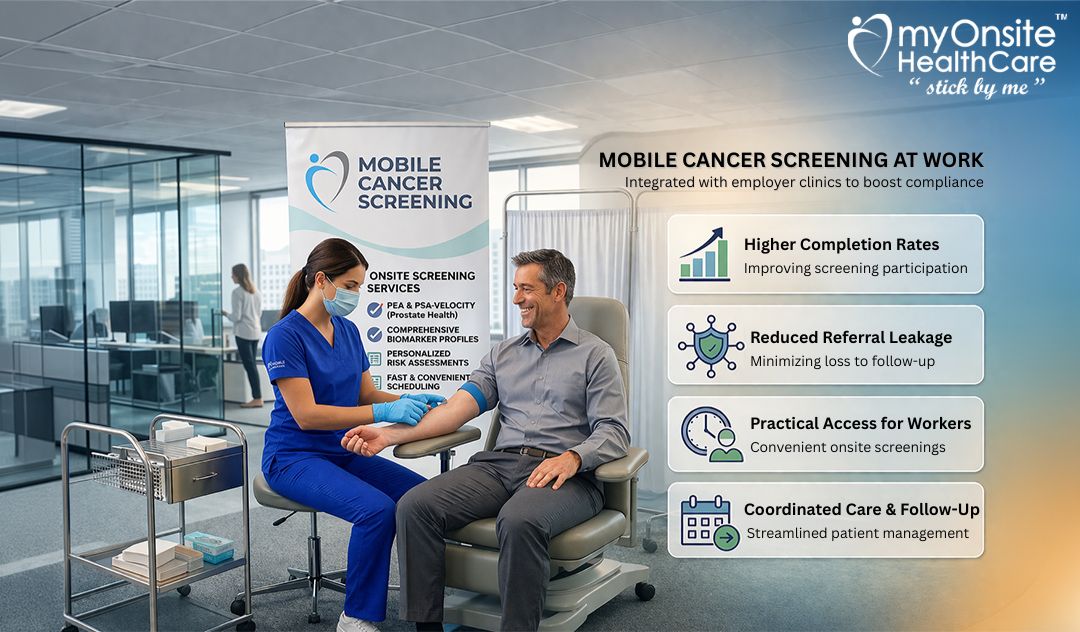
- Completion improved when screening was easier to access
- Fewer drop-offs were seen between recommendation and actual screening
- Access became more practical for shift-based and time-constrained workers
- Follow-up improved, as results stayed within a coordinated system
Nothing here relies on adding complexity. The change comes from reducing unnecessary steps.
Why This Matters for Employers and Healthcare Providers
Preventive programs often struggle with participation, even when awareness is high.
This research shifts the focus from “encouraging action” to making action easier.
For employers and healthcare providers, that translates into:
- More consistent screening participation
- Earlier identification of potential conditions
- Better alignment between health programs and real-world behavior
There’s also a broader takeaway. When care fits into a person’s routine, instead of disrupting it, follow-through becomes more likely.
Implementation Insights from the Research
The model described in the study follows a clear, practical structure:
- Identify individuals due for screening
- Prioritize outreach based on screening history and risk
- Keep scheduling simple and accessible
- Provide screening onsite or through mobile units
- Ensure results and follow-up remain connected
- Track completion and identify gaps over time
The shift is subtle but important—screening moves from a recommendation to something actively managed.
Closing Note
This work led by Dr. Hinal Panchal and Mr. Mayank Trivedi highlights a gap that is often overlooked, not in knowledge, but in execution.
It reinforces a simple idea: improving healthcare access does not always require more intervention. Sometimes, it requires fewer barriers.