
After a home blood draw, most people don’t really think about what happens next.
The visit is quick, everything feels routine — and then the sample leaves with the phlebotomist. From the patient’s side, that’s usually where it ends.
But once that sample is out the door, how it’s handled matters more than most people realize.
And with services like home blood draws becoming more common, that behind-the-scenes part is starting to matter a lot more than it used to.
How do blood samples actually get to the lab safely?
In simple terms, it’s a controlled handoff from patient to lab.
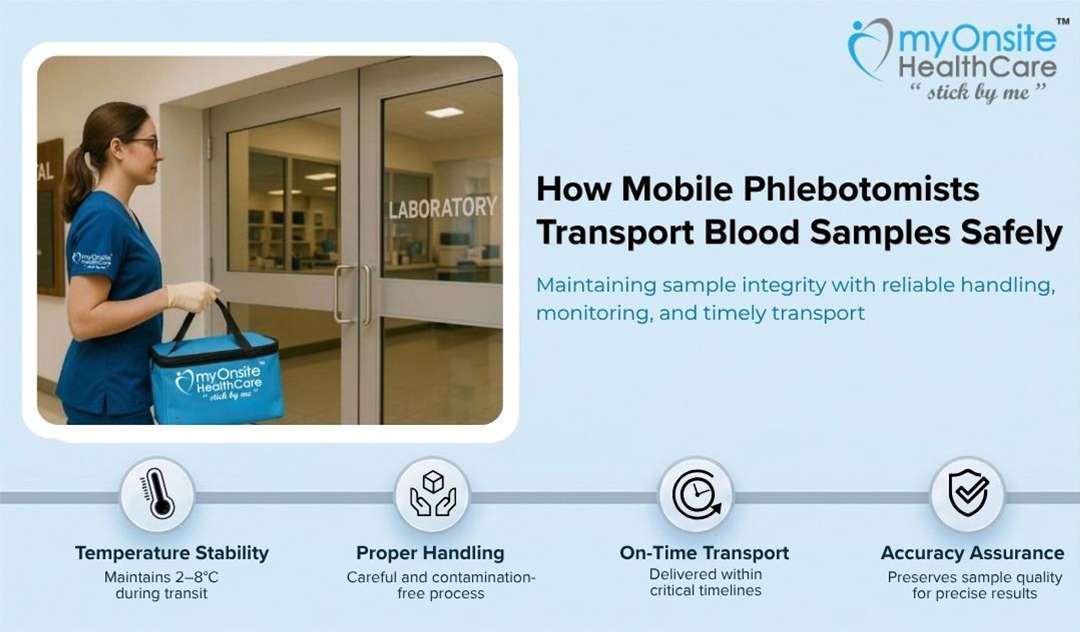
Mobile phlebotomy sample transport involves collecting, labeling, temperature-managing, and delivering blood samples within strict time limits so results stay accurate.
It’s not just packing and driving
Every sample has its own “rules.”
Some need refrigeration. Others can’t get too cold. A few even need to stay out of direct light.
That’s why professionals offering mobile phlebotomy services don’t treat transport as an afterthought — it’s planned from the moment the draw starts.
Most people don’t realize how much thought goes into this before the sample even leaves the house.
What’s actually in the transport kit?
It’s more than a cooler.
A typical mobile setup includes:
- Insulated, temperature-controlled containers
- Ice packs or phase-change materials
- Leak-proof specimen bags
- Absorbent layers (just in case)
- Tube holders to keep everything stable
These setups follow strict safety protocols, including WHO guidance on safe transport of infectious substances.
Timing can make or break a sample
Some samples are only usable for a short window — sometimes less than an hour.
So phlebotomists are constantly balancing:
- How far the lab is
- When the sample was drawn
- Traffic (yes, it matters)
- The specific test requirements
It’s not just a drive — it’s more like a moving schedule that has to stay on track.
What can go wrong if transport isn’t handled right?
A few common issues:
- Hemolysis (when blood cells break down)
- Temperature shifts
- Delays in processing
- Contamination
And this isn’t rare — studies show that pre-analytical errors account for up to 70% of lab mistakes.
That includes everything that happens before the sample even reaches the lab — especially transport.
Why this matters more with home visits
In a clinic, samples go straight to the lab.
At home, it’s different.
With home blood draws, the phlebotomist becomes the connection between you and the lab — and everything depends on that handoff going smoothly.
From what teams at myOnsite Healthcare see every day, when transport is done right, patients don’t even notice it.
Which is exactly how it should be.
Safe transport isn’t just a technical step — it directly affects your results.
When everything is handled properly:
- Results are accurate
- There’s no need for redraws
- Diagnosis happens faster
When it’s not, delays happen — and sometimes the whole process has to be repeated.